In today's competitive business environment, reaching the right audience is one of the biggest challenges for B2B companies. Sales and marketing teams need accurate business information to identify potential customers, connect with decision-makers, and build meaningful business relationships.
This is where a reliable B2B data provider becomes valuable.
A quality B2B data provider helps businesses access relevant company information, professional contact details, industry insights, and other business intelligence that supports prospecting and marketing activities.
However, choosing the right provider is not always easy. With many B2B database providers offering different services, businesses need to understand what makes a database reliable and useful.
In this guide, we explore the important factors to consider when selecting a B2B data provider for your business.
What Is a B2B Data Provider?
A B2B data provider is a company that supplies business-related information to organizations for sales, marketing, prospecting, and market research purposes.
Depending on the provider, this information may include:
- Company names and business profiles
- Industry classifications
- Company locations
- Professional contact information
- Job titles and decision-maker details
- Company size and employee information
- Technology usage and business insights
Businesses use this information to identify relevant prospects, understand target markets, and improve their sales and marketing strategies.
Why Does Choosing the Right B2B Data Provider Matter?
Business data plays an important role in modern B2B marketing. However, inaccurate or outdated information can create unnecessary challenges for sales and marketing teams.
Choosing the right provider can help businesses:
1. Reach Relevant Decision-Makers
Accurate professional information helps sales teams identify people who are relevant to their products or services.
2. Improve Prospecting Efficiency
A well-organized B2B database can reduce the time spent manually searching for potential customers.
3. Support Targeted Marketing Campaigns
Businesses can organize prospects based on industry, location, company size, and other relevant characteristics.
4. Improve Data Quality
Reliable data sources and regular verification processes can help reduce outdated, incomplete, and inaccurate records.
5. Support Business Growth
Relevant prospect information helps organizations build stronger sales pipelines and identify potential market opportunities.
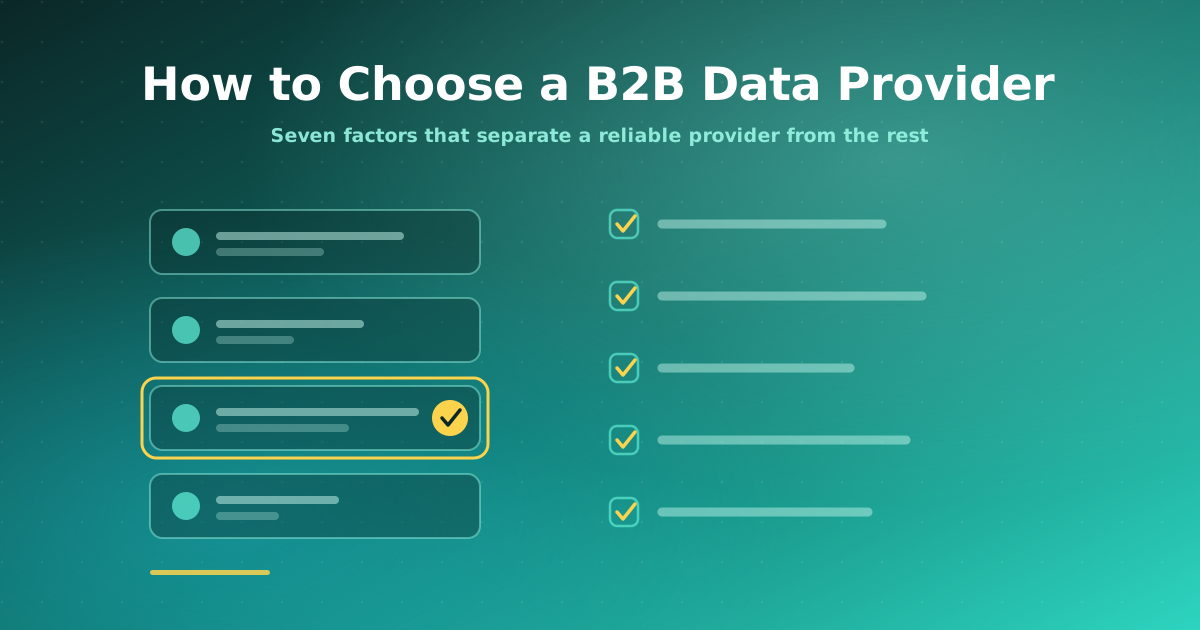
7 Important Factors to Consider When Choosing a B2B Data Provider
Not every B2B database provider offers the same level of quality, coverage, or service. Before choosing one, evaluate these seven important factors.
1. Data Accuracy and Verification
Data accuracy should be one of your first considerations.
Business contact information changes regularly. Employees move between companies, professional roles change, and organizations update their contact details.
An effective B2B data provider should have a clear process for maintaining and verifying its database.
Look for:
- Regular data verification processes
- Updated company information
- Valid professional contact details
- Clear explanations of data sources
- Transparent data quality standards
Do not evaluate a provider only by the number of records it offers. The relevance and reliability of those records are equally important.
2. Industry and Geographic Coverage
Your ideal prospects depend on your target market.
For example, a technology company may want to connect with IT decision-makers, while a financial services company may target finance professionals and business owners.
Before selecting a B2B data provider, check whether its database covers your required:
- Industries and business sectors
- Countries and geographic regions
- Company sizes
- Professional roles
- Business categories
A provider with relevant industry coverage can make it easier to identify prospects that match your ideal customer profile.
3. Access to Relevant Decision-Makers
Reaching the right people is essential for effective B2B prospecting.
A useful B2B contact database should help businesses identify relevant professional roles and decision-makers.
Depending on your target audience, you may need information about:
- CEOs and founders
- Marketing directors
- Sales managers
- IT decision-makers
- Procurement managers
- Operations executives
Always check whether the available contact information is appropriate for your intended business use.
4. Database Segmentation and Targeting
A large database is not necessarily a useful database if you cannot organize it effectively.
Look for providers that support relevant segmentation options, such as:
- Industry
- Company location
- Employee size
- Job title
- Business category
- Technology usage
These filters can help marketing teams build more focused prospect lists instead of approaching broad, unrelated audiences.
5. Data Privacy and Compliance
Data privacy should never be overlooked when selecting a B2B database provider.
Businesses must understand where their data comes from and whether it can legally be used for their intended activities.
Before purchasing or using business contact data, ask the provider about:
- Data collection methods
- Applicable privacy regulations
- Lawful basis for processing, where required
- Consent requirements, where applicable
- Opt-out and suppression processes
- Data retention and deletion policies
Depending on the markets you target, regulations such as GDPR and applicable email marketing and privacy laws may affect how business contact information can be collected and used.
6. Customer Support and Customization
Different organizations have different prospecting requirements.
Some businesses need a broad company database, while others require highly specific industry or professional contact segments.
A reliable provider should clearly explain its available services and whether it can accommodate your targeting requirements.
Consider:
- Customer support availability
- Custom data requirements
- Delivery formats
- Integration options
- Data quality assistance
Good communication and transparent service terms can make a significant difference in the overall experience.
7. Pricing and Overall Value
Price is another important factor, but choosing the cheapest B2B data provider may not always be the best decision.
Compare providers based on:
- Data quality
- Available records
- Industry coverage
- Verification methods
- Customization options
- Customer support
- Contract and refund terms
Evaluate the overall value rather than making a decision based only on database size or price.
B2B Data Provider vs. B2B Database Provider: Is There a Difference?
These terms are often used interchangeably, but they can describe slightly different offerings.
| B2B Data Provider | B2B Database Provider |
|---|---|
| Offers multiple business intelligence and data-related services | Focuses on access to structured business information |
| Includes company information, contact data, enrichment and intent insights | Includes searchable company and contact records |
| Suited to teams that need data plus marketing support | Suited to teams that need records to work with in-house |
The right choice depends on your business requirements and the type of information you need.
How B2B Data Supports Modern Lead Generation
B2B data can support several stages of the lead generation process.
Step 1: Identify Your Ideal Customer Profile
Define the industries, company sizes, locations, and professional roles that match your target audience.
Step 2: Research Potential Businesses
Use relevant company information to identify organizations that fit your ideal customer profile.
Step 3: Identify Relevant Contacts
Find professional roles and decision-makers within the target organizations.
Step 4: Segment Your Prospects
Organize prospects into relevant groups based on business requirements.
Step 5: Execute Targeted Outreach
Develop relevant, personalized communication while following applicable marketing and privacy requirements.
Step 6: Measure Campaign Performance
Evaluate engagement, qualified opportunities, conversion rates, and overall campaign effectiveness.
Why Businesses Consider Data Marketics for B2B Marketing Solutions
Finding relevant business information is only one part of building an effective B2B marketing strategy. Businesses also need solutions that support their broader demand generation and lead generation objectives.
Data Marketics focuses on B2B marketing and lead generation solutions designed to help businesses connect with relevant audiences and develop their sales opportunities.
Its service areas include:
- B2B Lead Generation
- Demand Generation
- Intent Data
- Content Syndication
- Appointment Setting
- Data Enrichment
By combining relevant data strategies with targeted marketing activities, businesses can work toward more effective prospecting and demand generation.
Final Thoughts
Choosing a reliable B2B data provider is an important decision for businesses looking to improve their sales prospecting and marketing activities.
Rather than focusing only on database size, evaluate data accuracy, industry coverage, relevant decision-maker information, privacy practices, and customer support.
The right data strategy can help businesses identify suitable prospects, improve targeting, and build stronger opportunities for long-term growth.
How Data Marketics can help